Episode Transcript
[00:00:01] Speaker A: Hey, guys, this is naive. And you've reached the Mosaic Church Podcast. So excited that you're part of our listening community, and I'd love for you to be even more connected. So check out our website. There's more content there, and there's more opportunities for you to get connected in our ministries and events as well. Also, love for you to share this content if this has blessed you. I know that God wants to use you to bless other people with it, so share this podcast.
Lastly, would you consider supporting this ministry? This is made possible by other people's generosity, and I'd love for you to pay it forward.
Join us to reclaim the message and the movement of Jesus together. So would you consider giving to this ministry? I know that God is able to do immeasurably more through us when we come together. Thank you so much. God bless you and enjoy.
[00:00:59] Speaker B: Good morning, Mosaic. Good morning. Good morning.
So happy to have you with us this morning.
I need to know. I learned something this week, and now I need to know who exactly is in the room. Okay. Have you ever had a conversation with somebody where you get to the end of the conversation or maybe halfway through, and you're like, you are not getting what I'm saying at all?
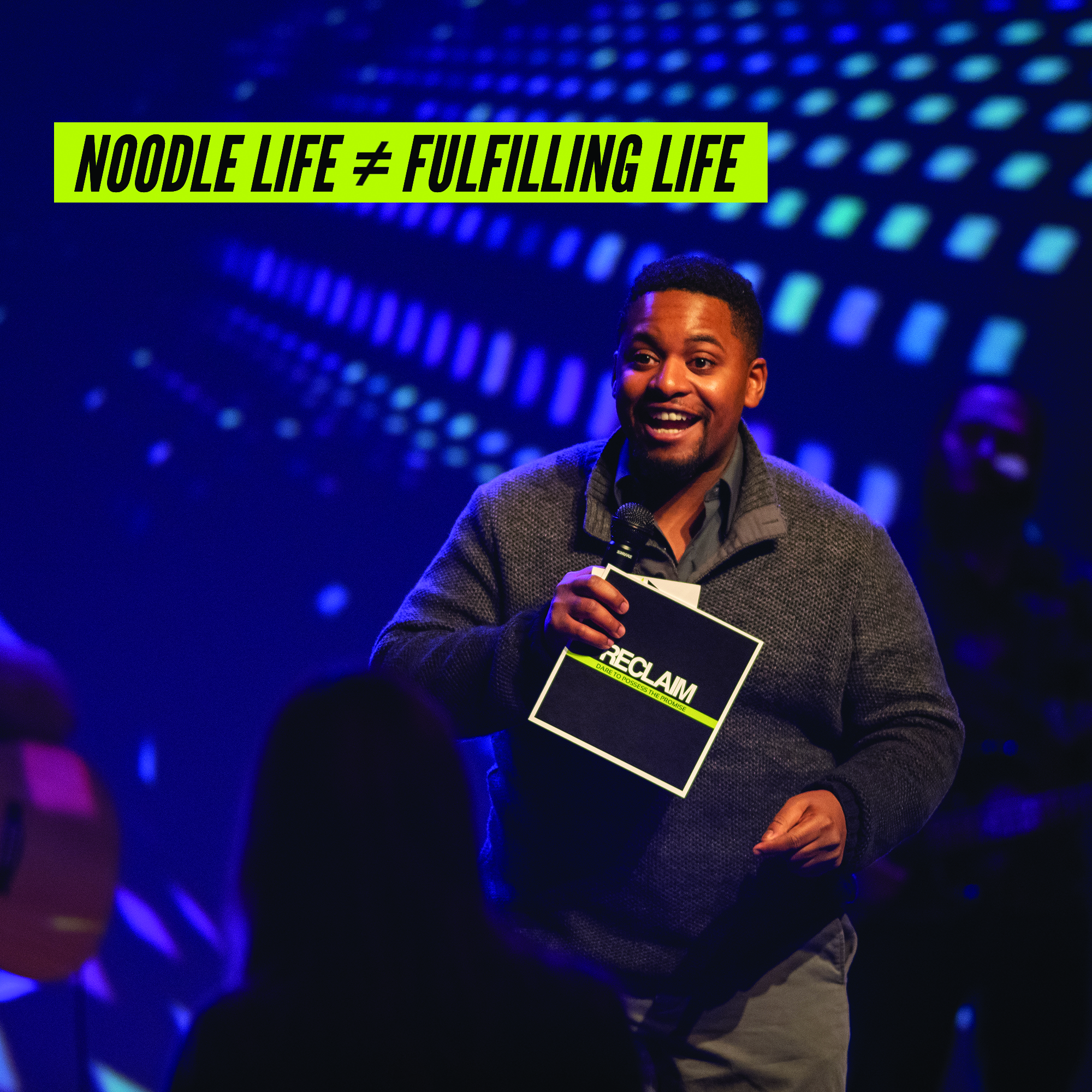
Yes, every day. That's because you are an educator, Meredith. Okay. All right. So I learned something scientific this week, that there's two kinds of brains, okay? There is a waffle brain, which is like, think about a waffle, right? Everything is linear and compartmentalized, and everything is, like, straight. And so there's a little here's where your emotions go, and here's where your thoughts go, and here's where you're processing, and everything is, like, compartmentalized.
The other kind of brain is a spaghetti brain. Okay? So then picture a bowl of spaghetti noodles where everything is, like, touching and overlapping, and you're not actually sure where one starts and the other ends anymore. Might go to pull one out and something else comes out instead. Okay, how many of you in this room are waffle brain people?
Okay. I was like, same as last service. The waffle brains are quiet. They're like, we are linear. We raise our hands. This is what we do.
How about the spaghetti brain people? Yeah, okay, me too. You're like, we know. We've heard your sermons. Okay. I am also a spaghetti brain. And this year, I also was diagnosed with adhd.
So if you think about the movie Elf, you know, the scene where he eats the spaghetti and he adds on, like, chocolate syrup, and there's, like, chunks of Pop tarts sprinkled. I think that's exactly what's happening in my brain. Like it's fun, maybe not exactly as intended. Okay, so hopefully you'll be able to see through all of what I have for you this morning. And the reason that I'm telling you this, because we are going to see immediately when we jump in to Ephesians chapter three in verse one, that I'm pretty sure Paul also was a spaghetti brain. And just maybe might, could possibly have benefited, as do I, from the marvels of modern medicine to help him stay on track. Let's jump right in with Ephesians 3. 1.
Paul is going. And he says, when I think of all this, because remember, we're now in the middle of this letter.
I, Paul, a prisoner of Christ Jesus, for the benefit of you Gentiles.
And then he just stops. Then he interrupts himself like, whoop. Like one of those little spaghetti noodles just kind of takes over and swirls around. Because then when we get to verse two, he's interrupting himself and he's like, hey, I'm assuming, by the way, that, you know, God gave me the special responsibility of extending his grace to you Gentiles.
He's like, you do know, right, why I'm writing you this letter from jail? Cause I'm the one that God picked to make sure that I fill you guys in and we're all on the same page.
So then he keeps going, he tangents like that for a couple of verses. And then we see verse six. He says, okay, this is God's plan.
Both Gentiles and Jews who believe the good news. And that is the good news that Jesus came and died to reconcile us back to God.
This good news is both for the Jews and the Gentiles to share equally in the riches inherited by God's children.
Both are part of the same body and both enjoy the promise of blessings because they belong to Christ Jesus. And so he's kind of doing a little recap here from what he talked about in chapters one and two. So if this is your first time in our Ephesians series, three weeks in, don't worry, you're good. Okay.
Cause we're gonna recap for you really quick. And so basically what Paul is saying is what he wants them to know and for us to know is that before Jesus, just the people of Jewish tradition and Jewish faith belonged to Yahweh. The Father created God. He was the only one that they worshiped, and they were the only people who worshiped him. But after Jesus God extended that family. And the invitation was now open to everyone. And so Paul is saying, like, hey, I wanna make sure you get this. You're in now, too.
You are also in the family.
And while it was news to the Gentiles that all of a sudden they got to be in this family, this club that they'd never been invited into before, it was not a surprise to God.
It was not a surprise to God, as we're gonna see in verse nine, Paul says, I was chosen to explain this mysterious plan that God, the creator of all things, had kept secret from.
Now, I'm gonna pause here for just a second because this mysterious plan, this, like, secret of God, can throw people off sometimes. But let me just ask you this. Have you ever known something before someone else?
Yeah, probably right? Maybe it's a surprise party. Maybe it's a fun plan. Maybe it's gossip. Sometimes you know it before other people.
Okay. My husband Peter and I, a couple of years ago, we decided to surprise our girls with a trip. And so they didn't even know that we were going anywhere. And so we picked them up from school and we took them to the airport.
So the destination was a mystery.
They didn't know where we were going.
The trip was a surprise for them.
Peter and I knew all along that this trip was going to happen. We were putting things in place while they did not know, so that when the right time came, we would be able to do the. The plan. Carry out the plan.
Now, I will let you know that the surprise trip was to Disney World. And so while Peter knew for a couple months, I knew this trip was gonna happen from the moment I got pregnant, it's like, this is going to take place and hallelujah, it did. It did. That's what we're talking about, about a mystery here. Okay? It's not like something super secret. It's just God did not reveal this plan to them until the right time. And I want us to understand this because it's so important for what Paul is going to set up. God did not change course after Jesus was killed, buried, and resurrected.
When Jesus ascended back to heaven, he and God did not sit down over pumpkin spice lattes and be like, what are we gonna do now?
Like, this was the plan all along for all people to come in to be part of God's family, that all people would be included, that all people would receive the blessings of being adopted into God's family. And what are those blessings? I think there's a lot. But belonging, love, inclusion, inherent value, Forgiveness, redemption, the new opportunity to try again when you feel like maybe you're not acting the way God's kid should.
These are all blessings that are available to all of us. And so now Paul is saying, it's time for everyone to know. Let's fill everyone in on the secret. And friends, this is where we come in. In verse 10, it says, God's purpose in all of this was to use the church to display his wisdom in its rich. Help me with this word variety, huh? In its rich variety. Think about like the 64 variety pack of crayons, the one with the sharpener on the back. There's a lot of variety, lots of different colors, right?
God wanted to use the church to display his wisdom in its rich variety to all the unseen rulers and authorities in the heavenly places. This was his eternal plan, which he carried out through Christ Jesus our Lord. God's plan for people was always to be in one united family.
God's plan for the church was for those people to display, to exhibit, to demonstrate God's unity in our variety.
He meant for the church to display God's unity in our diversity and in our, our differences.
Now, I don't know about you, I am not always a great representation of God's unity with different people.
Because God really did say, I'm gonna make a lot of different people with a lot of different opinions and a lot of different personalities. And he said, let's put em all in the same family.
And I'm gonna be honest with you, sometimes I look around at the people in our family and I'm like. And I mean our global family, let me be clear.
And I'm like, I kind of. I wouldn't be mad if your invitation got lost in the mail.
Some of you feel that right now. Cause Thanksgiving's coming up and you're like, God? Really?
Are you sure? Like we're all supposed to be around the table at Thanksgiving. We're all supposed to be together in this family.
It's not hard to look around and see the things that divide us right as a body. It's not hard to look around. There's racism, there's misogyny, there's xenophobia, which is really just a fancy word of saying that we're afraid of anybody who is different from us.
It's not hard to look around and see the things that divide us. But it is hard to choose unity when we are around people who are different from us.
This is one of the reasons that we started a podcast and it's called Becoming church, because the goal was to equip you in this process, just like Paul was writing about church, to become the church of God's original plan, to equip you, to become people who do display a value of the variety of God's people. In this family, There are almost 200 episodes to help you with different struggles and different phases of your spiritual growth.
In an upcoming episode, I believe it's next Sunday, I Talked to Chuck DeGroat, who is an author and a researcher, and he has done a lot of work with narcissism, especially in the church. And he has a new book out called who you're becoming. And this is a book, another book about transformation and how if we truly want people to change, especially within the church, what we actually have to do is shift our focus away from solely looking at morality and giving people more practices.
And we need to understand when our nervous systems are in survival mode.
We need to pay attention to biologically and physiologically what's happening to our bodies.
Because what's true of all of us is that we are becoming who we're becoming partly because of what we have experienced in our past.
I've got multiple ladies in here from my Ephesians small group, and we talked about that this week. How certain people can go through an experience, and it can send you one way if you trust God to move in it and to work in it and to grow you in those things. Or it can turn you into a very different kind of person if you don't.
And so what Chuck had found and what we were talking about is that what happens is if we struggle to trust that God is present and that God is working, then what happens is, instead, we adapt to our situations.
And these are not just the good things we like to think about, the good experiences that are shaping and forming us. But it's also the hard things, the traumatic things, the scary things.
And if we don't trust that God is working for our good, then we adapt to the situation, to the people around us. And we might say things like, well, it is what it is, or they showed their true colors, and now I know who that person is.
We might start to put up walls and operate out of defense mechanisms.
We start to surround ourselves with people who only tell us about the good parts of ourselves.
And then what happens is we start to believe them.
And so then we start to think that the happy, shiny version of ourselves that we put out in the world is actually the real, true version and who we really are.
And then when someone Comes in and says, hey, I have a little feedback on something that maybe you could shift.
It feels like a threat to us.
And we tell ourselves the narrative that that person isn't trying to help us grow or to help us in connection, but that they're just trying to hurt us or control us.
So the only way to bring unity among all people is to be honest about the woundings that we're carrying that resist connection with certain people.
And we could do a whole nother message on boundaries and safety and how to make sure that you are in relationships where you are not actively being harmed. Okay, hear me.
But what I'm talking about here is recognizing when we take old wounds and things and we project them onto another person, group, or people as a whole and say, because of this, I no longer can have unity with other people.
So I'd encourage you this week to kind of self reflect. Think about things that people you trust have told you are there patterns. Pray about it. Ask Holy Spirit to show you the places that you are blind to and to reveal the things that are keeping you stuck in the survival mode.
Maybe it's your need to be right that keeps you from hearing what you're doing that is maybe even unintentionally hurting others, but hurting other people.
Maybe it's your drive for achievement that leaves you with no margin to even engage with other people.
Maybe it's a fear of conflict. And so instead of being honest with yourself, with other people, with God, about the wounds and the hurts that you have, you avoid people, you stay away from them. And eventually you just find that you're cutting everybody out of your life.
It might be your need for reassurance. And so you kind of live in these insecurities that don't let you get close to anybody. Because it's hard to get close to people when you're constantly asking and wondering and doubting if what they're telling you about how they feel about you is true.
There are a lot of different things that we have within us that we probably should go to therapy to have some help working out if we've been caring for a really long time.
As we are also praying for the Holy Spirit to come in and help heal these wounds in our hearts. God, I encourage you to think about what is the one thing that will fundamentally change the way that you interact people. Just one. One thing that will help you to show up better as a reflection of God that will help you to show up better as someone who values that variety of all God's different People, I'm going to keep going. In verse 12, Paul says, Because of Christ and our faith in him, we can now come boldly and confidently into God's presence.
So please don't lose heart because of my trials here. And then he throws in this very funny line, I am suffering for you, so you should feel honored.
It's like, I'm in jail, I'm suffering, I'm doing it. God told me to. But also, do you want to tell me that I'm good for doing it? Like, if you want to hype me up a little bit, that'd be fine. You should feel honored. Paul's like, I want you to say this with your full chest. I am a child of God and I have direct access to his presence.
I want y' all to say that right now. I am a child of God and I have direct access to his presence.
We have to get to a place where we're not just saying and thinking these things in our head, but we're actually believing them in our hearts.
Because when we do actually understand that we can go through things that are hard and not lose heart. We can understand that trials and suffering are not a sign of weak faith or God not being present with us anymore.
See, I think the church has a history of accidentally romanticizing what it looks like to follow Jesus, where we're like, pray, read your Bible, get in a small group, maybe tithe a little money, maybe tithe a lot of money. I'm just saying, okay? We're like, do the things and then you'll follow Jesus and it'll be great.
And then when it's hard, we're like, wait, what?
What happened?
Why is this not working the way it's supposed to work? I thought I would just, like, read the words, do the things. This would be great. I didn't know people were gonna get mad at me about the way I followed Jesus.
I actually think that surrendering our lives to Jesus is more like the game of operation, my friend. TR, Will you give TR a hand? He's gonna bring out.
Thank you, friend.
Okay, anybody remember the game of operation?
Okay.
I actually think this is what surrendering life to Jesus is like.
Because what we have to do is we have to get inside of us and see what's actually in there. And some of it is God given stuff, right? We've got a brain and agency and a heart and compassion and empathy and love. And we've got all kinds of stuff in here that is good that God gave us gifts and skills and all the Things that we want to grow, we're gonna leave those alone.
But there's other stuff in there that should not be in there. And what we have to do is we have to do the work to get it out.
And so we like metaphorical spiritual surgery.
We have to get in here.
Oh, wow. That is anticlimactic. Anybody play this game in the 80s?
Yeah. What happens when you. What used to happen when you hit the thing?
Right? That's what I was hoping for. This is what happens, guys. We get in and we start to pick. Look, my hand is shaking already because I'm getting so close. We go in there and we're like, all right. God, I'm gonna try to get out this thing that's not supposed to be in there. And it buzzes and it goes. And then we get scared, and so we stop and it takes longer than we want it to take, and it doesn't go exactly as planned. And sometimes if we're really focused, we can even get the thing out.
But then we get nervous because our hand is shaking and we drop it and it goes back in, and we're like, are you serious?
I gotta work on getting that out of me again.
Ridiculous.
And we get so nervous and so conditioned about suffering and trauma and things that are hard that every time we try, we just hear that in our brains.
And so we stop.
And, friends, that is how we get spiritually stuck.
That is how we get to the place where we stop growing. We stop pursuing spiritual maturity. And the next thing we know, we're wondering if God's even real or if he's still with us because we're not feeling his presence like we used to.
Not paying attention to the fact that we are actually the ones that have backed away.
We are actually the ones that have said, God, stop working in my life. God, I'm not listening to the places and the things in me that you want to grow.
And this happens to all of us, okay? Paul's encouragement here is not. Don't do that.
Don't have things be hard. Paul's encouragement here is, when life is hard, remember who you are. You are a child of God with direct access to his presence.
Paul is saying, the pride, the gluttony, the envy, the lust, the deceit, these things don't define you.
They don't define you. They're in you. And you should let God do spiritual surgery to get them out. But there are never going to be reasons for God to kick you out of his family.
There are never going to be reasons For God to say, I'm going to remove my love from you because of these things, that is never going to happen, friends. We get to live from that confidence that even when things are hard, even when we feel like we are broken and all messed up inside, we are children of God with direct access to his presence in all of the blessings that come with that.
Finally, now we get to verse 14, which is what Paul was trying to say from the very beginning.
And he starts it the exact same way as he did in verse one. He said, when I think of all this, and now we know what all this is, I fall to my knees and pray to the Father, the Creator of everything in heaven and on earth. I pray that out of his glorious riches he may strengthen you with power through his spirit in your inner being, so that Christ may dwell in your hearts through faith.
And I pray that you, being rooted and established in love, may have power on your own, in your own capacity, in isolation.
Nope. Help me out together with all the Lord's holy people to grasp how wide and long and high and deep is the love of Christ and to know this love that surpasses knowledge that ye may be filled to the measure of all the fullness.
Paul is using all of these opposite measurements, high and long and deep and wide, because he's trying to say, I need you to experience a love of God that cannot be contained.
I need you to experience a love of God that is not like the love from your parents or your spouse or your best friend or the person that you thought loved you unconditionally and then decided they didn't want to be in your life anymore.
Paul is like, I need you to get and experience this kind of love that is bigger than anything you have ever been felt.
That's what he wants his prayer for the church to be rooted in. And so he prays two one, that they would be strengthened internally and two, that they would be rooted in that kind of love.
And as we're becoming people who reflect God in the world, we have to ask ourselves, what does this look like?
Being strengthened internally really is about your faith. It's about the things that you believe and deepening what you believe and why you believe it. And so again, I would encourage you to maybe journal and we've got sermon notes and sermon questions in the app every single week. That's what we go through with our Ephesians, small groups. But if you're not in one, you can go through this on your own Journal question, ask.
But ask God, what does it look like to be strengthened in your spirit. Maybe it means that you start to make decisions from a place of trusting God instead of doing it on your own because you actually believe that he's going to show up. If you trust on him, maybe it means you notice what it is that starts to make you reactive. And so you ask God to help you trade your shame, your fear, your anger for peace, joy, self control, or fill in the blank fruit of the spirit that you're struggling to grow.
Maybe it means that you change the way you confess when you pray to God. And instead of focusing on just like the things that you're doing, which is really then kind of behavior modification, you actually start to confess when you have walked in a mistaken identity.
And what this could look like is instead of praying like, hey, God, I'm sorry I did a thing, I'm sorry I did a thing. Again, we start to pray prayers like, hey, God, I'm sorry I'm becoming a person that's led by my sin and therefore becoming a person that's not who you created me to be.
I'm sorry I'm becoming a person that's not my best version of myself or replication of you.
So can you help me to do that?
I just started doing this recently and I will tell you, there's a big difference, at least for me, between praying like, God, sorry I did a thing, and sorry I'm becoming this kind of person.
One of them is like, checklist, check the box. Okay, I did it.
The other one is like, oof, I felt that one. I actually think I mean it now.
So as we're growing on the inside, we're also learning how to operate out of a love that surpasses knowledge that doesn't make sense.
Which means we will start to do things that don't come naturally to us.
Maybe it means that you stop treating your co workers like competition or your friend group like competition, and you can learn to celebrate the success of other people because you know that celebrating their wins doesn't actually take anything away from you.
Maybe it means you stop keeping score in your marriage.
Because what becomes more important than winning is apologizing and connecting and staying in a good relationship with that person.
For the teenagers in the room, what this looks like for you is that you refuse to let your value be tied to the people that have decided you are good enough to be their friend.
You refuse to let your value be tied to who likes you, what they say about you, what you get invited into, because you know already that you are fully loved and accepted.
My teen is in here every time and it makes me cry every time.
As parents, what this means is we actually have to love our children through their mistakes so that we can show up with grace and patience and patience and patience so that we can love them through it.
Instead of assuming that our children walking around the world are reflections of our own worth and therefore need us to control their behavior to make us look good.
Maybe what it looks like to be rooted in love is that when evil interferes with human flourishing, we don't just extend our thoughts and prayers.
We actually allow ourselves to be inconvenienced so that we can go in and love our neighbors by intervening, by pushing back the darkness, by bringing justice to the people that are being harmed.
There are a lot of different ways that this can look in our lives.
Paul brings it all together in the last two verses in Ephesians 3, 20 and 21.
This is our benediction that we read every week. So if you've been around Mosaic for a while, it will seem familiar to you now, to him who is able to do immeasurably more than all we ask or imagine, according to his power that is at work within us. To him be glory in the church and in Christ Jesus throughout all generations, forever and ever.
And because we say this verse, these two verses every Sunday, sometimes we read them and we lose their meaning.
But what Paul is saying here is that this plan for unity was always meant to start in the church. Not just locally, not just Mosaic, but the global church, that big family of all variety of people that we talked about earlier.
That family is meant to display God's power through the way we live.
And if I can for just one second speak specifically to American Christianity right now, we are not doing a good job.
We are not doing a good job.
Pastor Naim is in Arizona right now speaking at a church there.
And he and I hopped on a call the other day after seeing how loud the division and the accusation from Christians was after this week's midterm elections.
And you see it on social media where, like you unfortunately kind of expect to see it, but you are also seeing it from news anchors and from pastors.
And in case you somehow missed it, what was happening is that people were dehumanizing other Christians and they were trying to invalidate people's identity as believers because of how they voted, because of one choice that they made. And yes, we have seen this happen on both sides of the political aisle.
So Pastor Naim and I were talking specifically about you and about us and about Mosaic. And who do we need to be in this moment?
What kind of church does the watching world need who is just seeing so much infighting in the family?
They need to see a church that's unified in grace and love and kindness and hope.
They need to see a church that doesn't judge people's entire character based on one decision that they make.
We need to see a church that doesn't require agreement for belonging and actually values and honors the different perspectives of people.
Now, some of you follow me on social media and you're like, ma', am, I know. Listen, I'm not saying that we cannot have strong feelings about politics.
I have very strong feelings about politics.
I believe fiercely that our faith should guide our actions and that that does apply in the voting booth when we're faced with policies that will either harm or protect our neighbors just as much as it does when we are walking around in the world.
And also, this verse tells us that God's power is in us to bring glory to God through the church.
And in order to do that, friends, and I am going to talk specifically to Mosaic right now.
I think in this moment, we need to do three things. We need to be a church that does three things. The first one is that we have to be a church full of people who recognize the imago dei, the reflection of God in every human life.
We not only recognize it, but we honor that value, even when they're people that we disagree with.
And so what that means for us at Mosaic is that we are going to continue operating in a value of kindness.
We are going to continue operating where we err on the side of love and grace, choosing to believe the best about people instead of bullying them into the people we wish they were.
We're going to honor all people.
The second thing we need to do, Mosaic, is that we have to be a church that builds bridges and restores connection.
And I will talk to myself here first. Kristen, listen, if you believe that you're right about a thing, especially when it comes to faith and politics, and you genuinely want to change the minds of people who have a different theological perspective than you, distancing yourself from them is not going to do it.
Sending them mean DMs on Instagram is not going to do it. Ask me how I know.
We have to get close.
We have to engage.
We have to be willing to listen to other people with compassion and curiosity to try to understand how they got to where they.
And then maybe we'll have the opportunity to Speak truth into a situation.
And so at Mosaic, we are gonna continue to be a space where people who had never sit together outside of here come in, pull up a seat, and sit next to each other at the same table.
We literally do this every month at Mosaic. Guess what? It's called the Table.
It's happening this Wednesday. And this Wednesday, we're gonna talk a lot more about, like, how do we tap into the supernatural power that's within us? Like, good, great. But how do I. What are the practicals? And what I love about the table is not just that we get to dig deeper and learn more about things. And I'll give you a heads up. We don't ever promise you answers, and we never promise you that you're going to walk away, like, knowing all the things.
But that's because the goal of the table is connection. The goal is to bring people together to have discussions where they can hear from someone else's lived experience.
They can hear, oh, I've never actually heard this scripture explained that way. And we can all walk away connected, better, understanding other people and then being able to use that for a deeper sense of growing in our faith.
So that's the second thing. The third thing we need to do is that we have to be willing to be wrong.
Just like, as individual people, we gotta be willing to get in there and see what's inside of us that's not meant to be there. As a church, we have to do the same thing.
We have to look at our systems and our groups and the things that we're doing and ask what doesn't reflect God's image and God's plan here.
And we have to have the humility to say, uh, it hurts to see that I don't like seeing it.
But also, I know it's gonna hurt more if we pretend that we don't and let it stay there.
Because then what will happen is we will become a community whose anger and cynicism and pride and hate turns us into a community where we start building walls to protect ourselves from people who don't agree.
So at Mosaic, we will continue to be a diverse community that lives by faith, is known by love, and is a voice of hope and is held accountable when we aren't doing those things.
This is who we need to be in this moment. And can I just encourage you if it feels like a lot, you are already doing it.
I could not be more proud of being a pastor at this church, because this is who you already are. These are the people that you are so if you feel like you're having an off day and you can't do it, there are so many people around you. We are one body. We hold each other.
This is who we are going to continue to be. Friends, God is at power. God has power and his power is at work in you. It is at work in you to do what you can't do on your own.
As we get ready to sing this last song, I want you to remind yourself of that.
I want you to remind yourself when you get distracted by fear. I want you to remind yourself when you feel like you're losing hope because you accidentally put all your hope into the hands of someone in a political, powerful position and all of a sudden you're scared for the future. I want you to remind yourself that God's power is within you.
See, when we are led by our fears and our worries and our anxieties and our hate, we forget that God's presence is within us.
The same resurrection power that resurrected Christ will calm our anxieties and overcome our hate with love and transform us into people that feel impossible.
Friends, God is with you.
God has more power than you can imagine. And God is working in it.
Let's live in the confidence of that.
Amen.
Amen.
I would love to. You can stand if you are able. I would love to pray for you this morning.
God, I thank you for these words of Paul. God, I thank you that even as he was encouraging and challenging the church, God, that these words are still true today, Lord, that even though they were not written to us, they can still be words that are for us, for us to apply and learn from.
And so, God, we do. We confess. Father, if we have been led by anything other than love, God, would you open our eyes and show us how we're acting in something else instead of the vastness of your love. God, we confess if we have let the fear of other people justify wanting to withhold that love from them or trying to keep them out of your family.
God, would you strengthen us internally and root us in your love as you continue to transform us to bring other people into your family?
God, as you continue to transform us to people who put your plan for the world ahead of our own personal preferences.
God, I thank you for the gift of the church. God, I thank you for this brilliant idea to take all of these different people and throw them all in together, God, so that we can encourage each other and strengthen each other, God, so that we can make mistakes and laugh and celebrate and mourn together.
God, I thank you for the gift of this body, Lord, Would you bring more people here, God? Would you help us to understand what this kind of community is, the gift that it is? God so that we would go out and reach out and invite in the people that don't know yet that they're not in their your family, God.
Not because they're not meant to be here, Lord, but because maybe no one has told them, maybe no one has made the invitation to say, hey, this is the the destination.
This is where you're meant to be.
God, thank you for these people. In Jesus name.
[00:38:18] Speaker C: Thanks for listening to this message from Mosaic church in Charlotte, North Carolina.
For more audio and video content, visit us at MosaicChurch TV.